Job Summary
- Job Type: Contract
- Location: Gaborone, Botswana
- Category: Health and Safety
- Salary: attractive remuneration
- Closing Date: 2026-10-06
Key Responsibilities
- Lead and oversee HSE systems, programs, and initiatives across drilling and project operations.
- Ensure compliance with company HSE procedures, client standards, legal requirements, and site-specific requirements.
- Develop and implement risk assessments, audits, inspections, incident prevention programs, emergency preparedness, and continual improvement initiatives.
- Monitor HSE performance, investigate incidents, identify root causes, and ensure corrective and preventative actions are implemented.
- Provide HSE leadership, coaching, and support to managers, supervisors, drillers, contractors, and site teams.
- Promote a strong safety culture and ensure employees understand their responsibilities for health, safety, environmental protection, and reporting.
Requirements
- Minimum 15 years’ experience in HSE within mining, drilling, construction, or heavy industry, including leadership responsibilities.
- Strong knowledge of HSE management systems, risk management, incident investigation, auditing, and environmental requirements.
- Proven experience working in remote or site-based operations.
- Strong knowledge of applicable Botswana HSE requirements and industry best practice is preferred.
- Relevant HSE qualification and recognised safety certifications are required/preferred.
- Strong leadership, communication, training, reporting, and problem-solving skills.
Salary
attractive remuneration
How to Apply
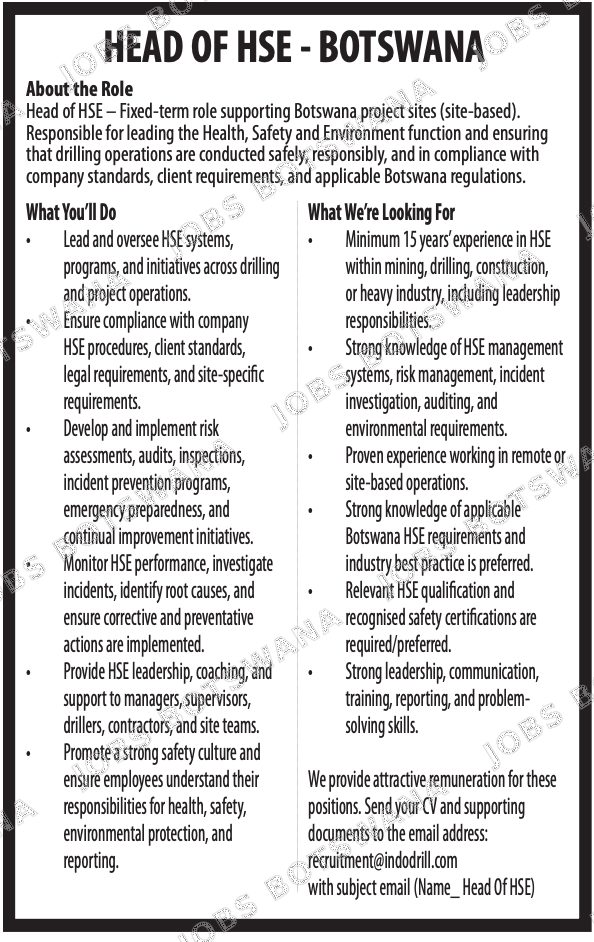
Original Advert
Source document for this listing, published by Jobs Botswana.
Frequently Asked Questions
What qualifications and certifications are typically required for a Head of HSE role in Botswana?
Most employers require a degree in Occupational Health and Safety, Environmental Science, or Engineering, plus NEBOSH International Diploma or equivalent. Local registration with the Botswana Registration Authority for Health and Safety Practitioners is often essential. Experience in mining, construction, or energy sectors is highly valued given Botswana's economic landscape.
What are the common day-to-day responsibilities of a Head of HSE in Botswana?
You will oversee compliance with Botswana's Mines and Quarries Act or Factories Act, conduct risk assessments, and lead incident investigations. Regular site inspections, training delivery, and liaison with government inspectors from the Department of Labour are routine tasks. You will also prepare monthly reports for senior management and board committees.
How does workplace culture in Botswana affect HSE leadership roles?
Botswana's workplace culture emphasizes respect for hierarchy and collaborative decision-making, so building relationships with unions and workers' representatives is crucial. Employers expect HSE leaders to balance regulatory enforcement with diplomatic communication. Understanding Setswana cultural norms around authority and community consultation strengthens your effectiveness.
What career progression opportunities exist for HSE professionals in Botswana?
Head of HSE can advance to Regional HSE Director covering Southern Africa operations, or transition into General Management roles. Specializing in emerging areas like carbon management or ESG reporting opens doors with multinational corporations. Some professionals move into consultancy or establish independent auditing firms serving Botswana's growing construction and mining sectors.
What benefits are typically included in Head of HSE packages in Botswana?
Standard packages include medical aid coverage, pension contributions to the Botswana Public Officers Pension Fund or private schemes, and annual leave of 20-25 days. Many employers provide housing allowances or subsidized accommodation, particularly in remote mining towns. Performance bonuses and professional development allowances for further certifications are increasingly common.
What do Botswana employers look for when hiring a Head of HSE, and how should I apply?
Employers prioritize demonstrated leadership experience, local regulatory knowledge, and a track record of reducing incidents in high-risk industries. Tailor your CV to highlight specific achievements and include verifiable references from previous supervisors. Applications are typically submitted through company websites, local recruitment agencies like HRMC, or directly to HR departments with a concise cover letter addressing the specific industry sector.