
Job Summary
- Type: full-time
- Location: Gaborone
- Category: Manufacturing
- Closing Date: 2026-09-12
Key Responsibilities
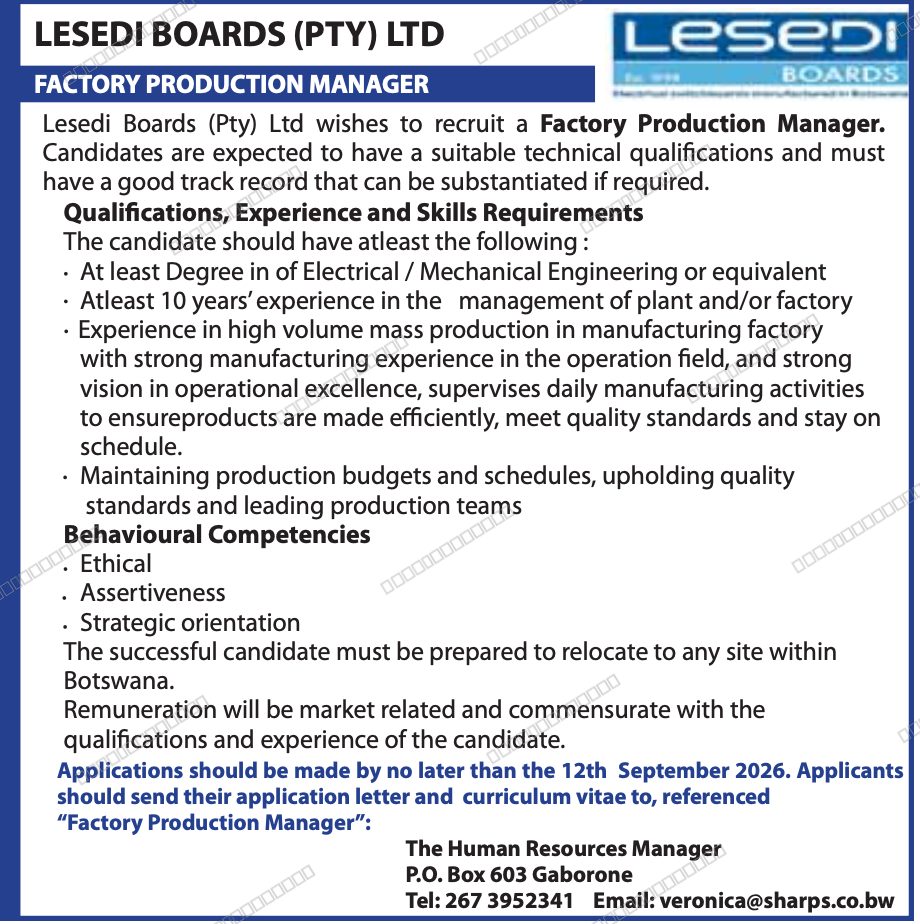
- Supervises daily manufacturing activities to ensure products are made efficiently, meet quality standards and stay on schedule.
- Maintaining production budgets and schedules, upholding quality standards and leading production teams
Requirements
- At least Degree in of Electrical / Mechanical Engineering or equivalent
- Atleast 10 years’ experience in the management of plant and/or factory
- Experience in high volume mass production in manufacturing factory with strong manufacturing experience in the operation field, and strong vision in operational excellence, supervises daily manufacturing activities to ensure products are made efficiently, meet quality standards and stay on schedule.
- Maintaining production budgets and schedules, upholding quality standards and leading production teams
Salary
Market related and commensurate with the qualifications and experience of the candidate
How to Apply
Original Advert
Source document for this listing, published by Jobs Botswana.
Frequently Asked Questions
What qualifications or certifications are typically required for a Factory Production Manager role in Botswana's manufacturing sector?
A bachelor’s degree in Industrial Engineering, Operations Management, or a related field is commonly required. Many employers also value professional certifications such as Lean Six Sigma (Yellow or Green Belt) or membership with the Botswana Institute of Engineers (BIE), especially for roles involving process improvement and compliance with local standards.
What does a typical day look like for a Factory Production Manager at a medium-sized manufacturing company like Lesedi Boards in Botswana?
Daily responsibilities include overseeing production schedules, coordinating with procurement and quality assurance teams, conducting safety briefings aligned with Botswana’s Occupational Safety and Health Act, and reporting progress to senior management. You’ll also engage directly with shop-floor supervisors and workers, often in Setswana or English, to resolve bottlenecks and ensure adherence to ISO or BOSIET standards where applicable.
How does workplace culture and management expectations differ for production managers in Botswana compared to other countries?
Respect for hierarchy and relationship-based communication are central—managers are expected to lead with approachability while maintaining authority, especially when addressing team performance. Punctuality, consensus-building in team meetings, and sensitivity to local holidays and community obligations (e.g., funeral leave under Botswana’s customary practices) are widely expected and valued.
What realistic career progression paths exist for Factory Production Managers in Botswana’s manufacturing industry?
With strong performance and local experience, professionals often advance to Plant Manager or Operations Director roles within larger firms or diversified industrial groups. Some transition into consultancy, training delivery accredited by the Botswana Qualifications Authority (BQA), or take on board-level advisory roles with support from institutions like the Botswana Exporters Association or BOI.
What standard employee benefits can I expect in this role, and how are they regulated in Botswana?
Employers typically provide statutory benefits including 24 days’ annual leave, sick leave per the Employment Act, and contributions to the Botswana National Pension Scheme (BNPS). Medical aid is increasingly common but not mandatory; many firms partner with local providers like Medshield Botswana or BONFIRE, and may offer family coverage depending on tenure and grade.
How should I apply for this role, and what do Botswana-based manufacturing employers specifically look for in candidates?
Applications are usually submitted via email or LinkedIn with a CV highlighting local manufacturing experience, familiarity with Botswana’s labour laws, and evidence of managing cross-functional teams in resource-constrained settings. Employers prioritise candidates who demonstrate problem-solving in real-world contexts—such as reducing downtime or improving yield—and who have engaged with local skills development initiatives like those supported by the Ministry of Employment and Labour Productivity.