Job Summary
- Employer: Botswana Hindu Charities Trust
- Job Type: Full-time
- Location: Gaborone, Botswana
- Category: Religious
- Closing Date: 2026-10-30
Key Responsibilities
- Conduct day to day prayers, important religious functions and also help devotees to understand the religious significance of various events and more importantly the deity worship.
Requirements
- He shall have undergone training for a minimum of five years in a Hindu religious organization or under a renowned Hindu Scholar in India.
- Knowledge of Hindu Vedas and a minimum of five years working experience in a Hindu Temple is essential.
- Certification of Training and Proficiency from a government agency or reputed religious institution will be an added advantage.
- He must be capable of performing all rites and rituals for the various Hindu deities strictly following the principles and traditions of Hinduism.
- He shall also have reasonable administrative abilities and excellent interpersonal and communication skills.
How to Apply
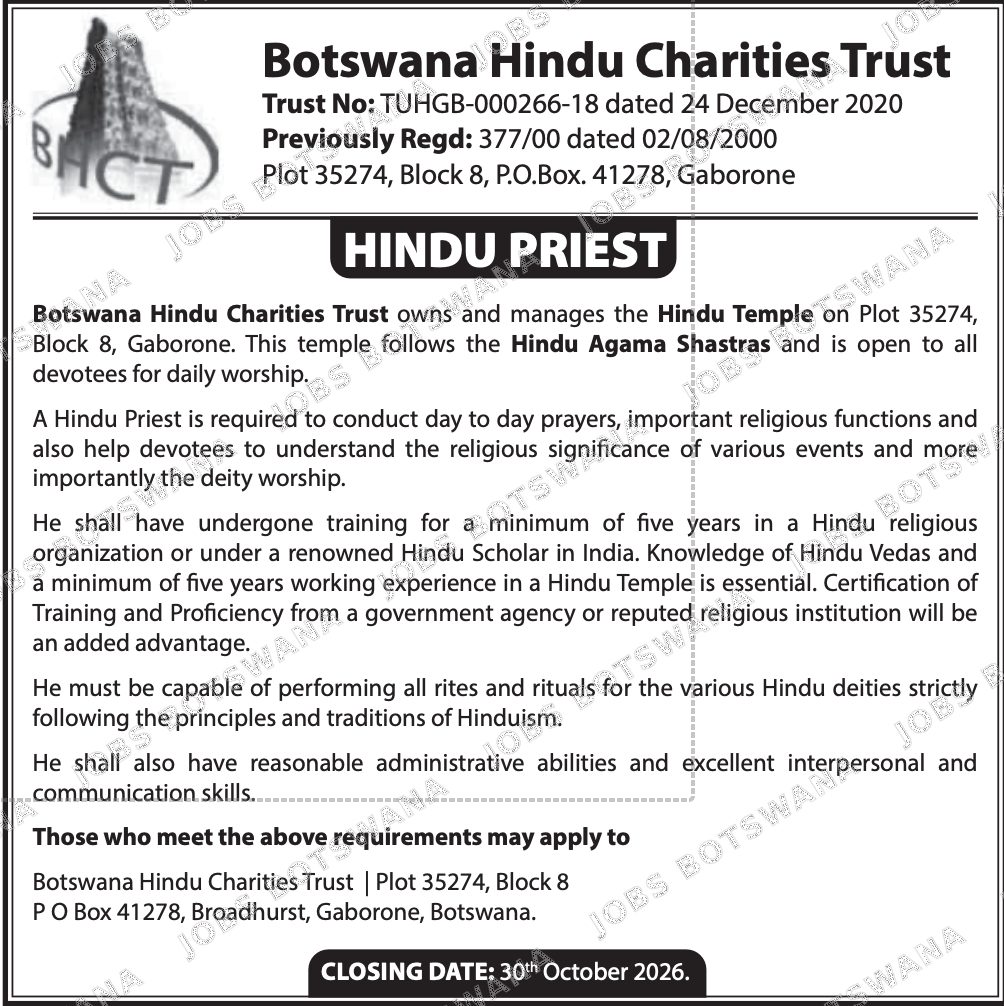
Original Advert
Source document for this listing, published by Jobs Botswana.
Frequently Asked Questions
What qualifications or training are typically required to become a Hindu priest in Botswana?
Most employers require formal training from a recognized Hindu seminary or ashram in India, South Africa, or Mauritius. Fluency in Sanskrit, Hindi, or Gujarati is often essential for conducting rituals. Some positions may accept extensive practical experience under a senior priest in lieu of formal certification.
What are the typical day-to-day responsibilities of a Hindu priest at a temple in Botswana?
Daily duties include performing morning and evening prayers (puja), officiating weddings and funerals, conducting religious ceremonies for devotees, and maintaining temple sanctity. Priests also provide spiritual guidance to the community and may teach Sanskrit or religious classes. Administrative tasks such as record-keeping and coordinating festival preparations are common.
How does the work culture for Hindu priests differ in Botswana compared to other countries?
Botswana's small Hindu community means priests often serve multiple roles and work closely with diverse cultural groups. Respect for local customs and interfaith sensitivity are highly valued given the country's Christian-majority context. Employers typically expect flexibility in scheduling around major Hindu festivals that may not align with public holidays.
What benefits are typically offered to full-time Hindu priests employed by religious organizations in Botswana?
Benefits usually include furnished accommodation near the temple, medical aid coverage, and a modest pension contribution. Annual leave often aligns with religious observances rather than standard calendar holidays. Some employers provide support for continuing education or travel to India for advanced training.
What career progression opportunities exist for Hindu priests in Botswana?
Experienced priests may advance to head priest (mahant) or temple management positions within larger trusts. Some transition into community leadership roles, religious education coordination, or advisory positions for Hindu organizations across Southern Africa. Establishing reputation through scholarly publications or interfaith work can open regional opportunities.
How should I apply for a Hindu priest position in Botswana, and what do employers prioritize?
Applications typically require submission of certified training credentials, reference letters from senior religious authorities, and a recorded sample of ritual performance. Employers prioritize demonstrated community service experience, adaptability to Botswana's multicultural environment, and strong interpersonal skills for pastoral care. Direct contact with temple committees or the Botswana Hindu Charities Trust is often more effective than generic job portals.