
Job Summary
- Type: full-time
- Location: Palapye
- Category: Manufacturing
- Closing Date: 2026-09-03
Key Responsibilities
- Designing, fabricating, repairing, and maintaining moulds for a variety of industrial applications.
- Working with precision, interpreting technical drawings.
- Solving production challenges.
- Delivering high-quality workmanship.
Requirements
- 10 years’ experience of practical mould-making design and fabricating.
- Skilled in maintenance and repairs of moulds.
- Able to work stainless steel fabrication of custom moulds and welding
- Strong knowledge of engineering tools, machines, and materials.
- Excellent problem-solving and attention to detail.
- Reliable, hardworking, and committed to meeting deadlines.
- Able to work independently or as part of a team.
- NCC in Fabrication with at least 10 years work experience using stainless steel will be an added advantage
- With many years of hands-on experience in fabrication and welding of stainless steel.
How to Apply
REF Code: VACANCY CIRCULAR NO 2 OF 2026 | Vacancy Circular No: VACANCY CIRCULAR NO 2 OF 2026
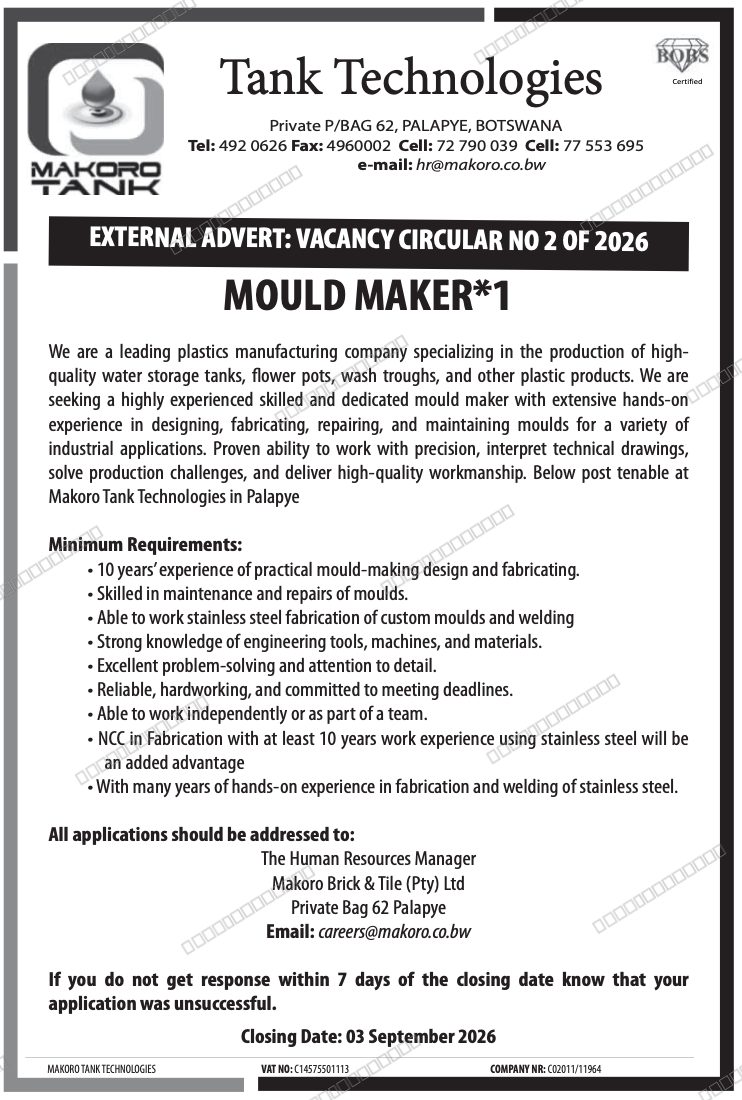
Original Advert
Source document for this listing, published by Jobs Botswana.
About the Company
Makoro Brick & Tile (Pty) Ltd is a leading manufacturing company based in Botswana, established in 1987. Situated in Makoro Village near Palapye, it has grown to be a key player in the country's industrial landscape. The company specializes in the production of high-quality clay bricks, serving the construction sector across Botswana. Additionally, Makoro Brick & Tile is recognized for its expertise in roto-moulding manufacturing, offering diverse industrial solutions. Through its operations, the company contributes significantly to local employment and the national economy.
Botswana's leader in clay brick and roto-moulding manufacturing.
Website: https://makoro.co.bw/
Frequently Asked Questions
What qualifications or certifications are typically required for a Mould Maker role in Botswana's manufacturing sector?
A National Certificate in Engineering (Metalwork) or equivalent NQF Level 4–5 qualification from a Botswana Qualifications Authority (BQA)-accredited institution is commonly required. Relevant apprenticeship completion under the Botswana Training Authority (BOTA) or trade test certification from the Botswana Bureau of Standards (BOBS) is highly valued. Employers may also accept substantial hands-on experience in mould fabrication, especially with brick and tile production equipment.
What does a typical day look like for a Mould Maker working in a brick and tile factory in Botswana?
Daily tasks include interpreting technical drawings to fabricate, repair, and maintain steel or aluminium moulds used in brick and tile pressing machines, as well as conducting routine quality checks and alignment adjustments. You’ll collaborate with production supervisors and machine operators on the shop floor, often under time-sensitive production schedules aligned with seasonal construction demand. Safety compliance — including wearing PPE and adhering to BOBS and Department of Occupational Safety and Health (DOSH) guidelines — is mandatory.
How does workplace culture and employer expectations differ for skilled tradespeople in Botswana compared to other countries?
Respect for seniority, punctuality, and strong interpersonal communication — often in Setswana or English — are central to workplace norms in Botswana’s manufacturing firms. Employers value reliability, willingness to mentor juniors, and adaptability to shift work, especially during peak production periods. Team-based problem-solving is encouraged, but formal reporting lines and hierarchical decision-making remain common in established local firms.
What realistic career progression paths exist for a Mould Maker in Botswana’s manufacturing industry?
With experience and additional BOTA-accredited short courses (e.g., CNC operation or quality assurance), you may advance to Senior Mould Maker, Toolroom Supervisor, or Production Technician roles. Some progress into technical training roles with BOTA or vocational institutions, while others pursue entrepreneurship in custom mould fabrication or maintenance services. Continued professional development through the Botswana Innovation Hub or local industry associations can support broader technical leadership opportunities.
What benefits are typically offered to skilled manufacturing staff like Mould Makers in Botswana?
Formal employers generally provide at least 21 days’ annual leave, statutory sick leave, and maternity/paternity leave per the Employment Act. Medical aid is increasingly common among medium-to-large manufacturers, though coverage levels vary; pension contributions are usually made via the Botswana Unified Revenue Service (BURS) under the National Pension Scheme (NPS). Some firms offer transport allowances or housing assistance, particularly in remote industrial areas like Selebi-Phikwe or Lobatse.