
Job Summary
- Type: contract
- Location: Gaborone
- Category: urban planning
- Closing Date: 2026-09-01
Key Responsibilities
- Provide technical leadership and undertake direct professional input in the preparation and delivery of the Integrated Land Use Management Plans (ILUMPs) until completion.
- Integrate Sustainable Land Management (SLM), ecosystem restoration, climate change adaptation, biodiversity conservation and adaptive natural resource management approaches into land use planning to support Land Degradation Neutrality (LDN), Ecosystem resilience, and evidence – based and implementable livelihoods.
- Deliver high quality, evidence – based and implementable planning outputs in accordance with applicable legislation and policies and project funding requirements.
- Undertake core technical work including spatial and land use analysis, environmental assessments and land suitability studies.
- Develop spatial development frameworks including land use proposals, strategies, planning scenarios and implementation frameworks supported by GIS- based spatial analysis and mapping. Implementation.
- Prepare technical reports and deliverables in close collaboration with the project team and undertake field investigations in accordance with the project timelines.
- Ensure quality control and assurance of all outputs, integrate stakeholder inputs into planning proposals and that the ILUMPs are coherent with the project results framework.
- Work collaboratively with the Department of Town and Country Planning, Department of Forestry and Range Resources, FAO, the National Project Coordination Unit and other implementing partners to achieve the objectives of the Miombi-Mopane Landscape programme.
Requirements
- A minimum of Bachelor’s Degree in Urban and Regional Planning/Rural and Urban Planning/City Planning/Town Planning.
- A Master’s Degree in Urban and Regional Planning/Rural and Urban Planning/City Planning/Town Planning/Project Management/Land Use Planning/Environmental Planning/Development Planning/Spatial Planning will be an added advantage.
- Applicants should be registered with Pula Institute of Town Planners.
- At least minimum of twelve (12) years relevant professional experience, of which at least five (5) years should be in the preparation of spatial plans, Integrated Land Use Management Plans (ILUMPs) and regional plans or similar assignments. Three (3) years should be at overseeing/supervision of spatial plans.
- Experience working in multi-sectoral planning environment.
Salary
E2 – (P449,256 – P467,436) per annum
How to Apply
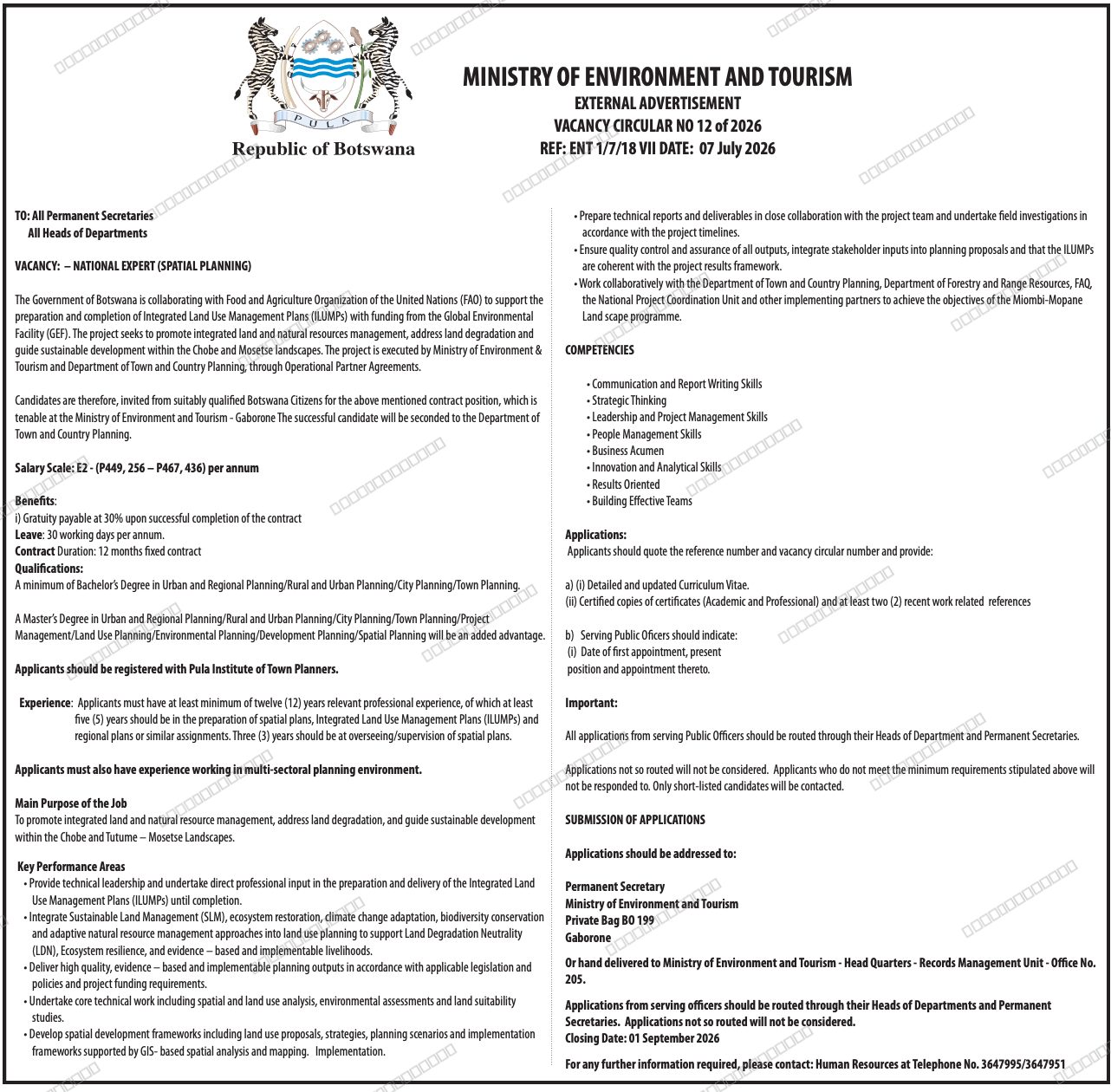
REF Code: ENT 1/7/18 VII | Vacancy Circular No: 12 of 2026
Original Advert
Source document for this listing, published by Jobs Botswana.
About the Company
The Ministry of Environment and Tourism is a ministry within the Cabinet of Botswana.
Frequently Asked Questions
What qualifications and certifications are typically required for the National Expert (Spatial Planning) role in Botswana?
A Bachelor’s or Master’s degree in Urban and Regional Planning, Geography, or a closely related field is essential, with preference given to candidates registered with the Botswana Institute of Architects (BIA) or the Botswana Institution of Professional Planners (BIPP). Relevant postgraduate training in GIS, land use planning, or environmental management—and experience applying Botswana’s Physical Planning Act and National Development Plans—is highly valued.
What does a typical day look like for a National Expert (Spatial Planning) working with the Ministry of Environment and Tourism?
Daily tasks include reviewing regional and local spatial development frameworks, advising on land use compatibility for tourism infrastructure projects, and coordinating with district councils on statutory planning applications. You’ll also participate in interdepartmental technical committees and support community consultations aligned with Botswana’s Integrated Water Resource Management and Vision 2036 priorities.
How does workplace culture and professional expectations differ for spatial planners in Botswana compared to other countries?
Workplaces in Botswana emphasise respect for hierarchy, consensus-building, and strong interpersonal communication—especially when engaging traditional authorities like Chiefs’ Councils or village development committees. Punctuality, formal dress codes in government offices, and adherence to public service ethics as outlined in the Public Service Act are expected across all planning roles.
What realistic career progression paths exist for a National Expert (Spatial Planning) within Botswana’s public sector?
Progression typically moves from National Expert to Senior National Expert, then to Principal Planner or Head of Spatial Planning Unit—often requiring additional leadership training and demonstrated success in national policy implementation. Some professionals transition into advisory roles with the Botswana Innovation Hub, UN-Habitat country programmes, or regional bodies like SADC’s Planning and Infrastructure Unit.
What standard benefits (leave, medical aid, pension) can I expect in this government role?
As a civil servant, you’re entitled to 30 days annual leave, full medical coverage under the Government Medical Aid Scheme, and mandatory pension contributions through the Botswana Public Officers Pension Fund (BPOPF). Maternity/paternity leave follows the Employment Act provisions, and study leave may be granted for approved planning-related further education.
How do I apply, and what do employers in Botswana specifically look for in candidates for this role?
Applications must be submitted via the Botswana Unified Recruitment System (BURS) or official Ministry announcements on gov.bw and the Botswana Gazette, including certified academic documents and proof of BIPP/BIA registration. Employers prioritise candidates with demonstrable experience in preparing statutory plans for Botswana’s districts, fluency in local languages (e.g., Setswana), and a track record of stakeholder engagement in rural and peri-urban contexts.