Job Summary
- Employer: AL-NUR SCHOOL
- Job Type: Full-time
- Location: Gaborone, Botswana
- Category: Education
- Closing Date: 2026-10-16
Key Responsibilities
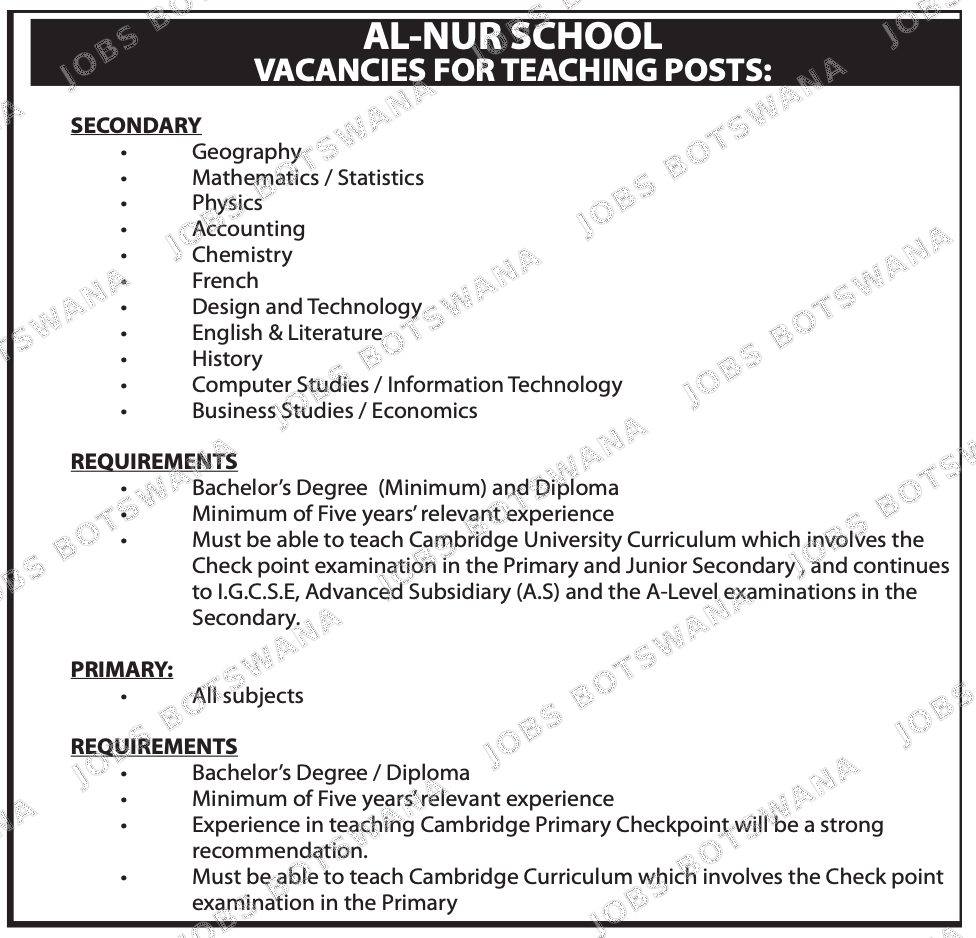
- Teach specified subjects at Secondary level: Geography, Mathematics / Statistics, Physics, Accounting, Chemistry, French, Design and Technology, English & Literature, History, Computer Studies / Information Technology, Business Studies / Economics.
- Teach all subjects at Primary level.
Requirements
- Bachelor’s Degree (Minimum) and Diploma
- Minimum of Five years’ relevant experience
- Must be able to teach Cambridge University Curriculum which involves the Check point examination in the Primary and Junior Secondary , and continues to I.G.C.S.E, Advanced Subsidiary (A.S) and the A-Level examinations in the Secondary.
Original Advert
Source document for this listing, published by Jobs Botswana.
Frequently Asked Questions
What qualifications are typically required for teaching positions at private schools like Al-nur School in Botswana?
Most private schools in Botswana require a minimum of a Diploma in Education or Bachelor's degree in Education from a recognized institution such as UB or BIUST. A teaching license from the Botswana Teaching Council is increasingly expected. Subject-specific qualifications may be required for specialized roles like mathematics or science teaching.
What are the typical day-to-day responsibilities of a teacher at a private school in Botswana?
Teachers typically handle lesson planning, classroom instruction, marking assignments, and preparing students for BGCSE and PSLE examinations. You will also participate in parent-teacher meetings, extracurricular activities, and school events. Administrative duties like attendance records and report writing are standard expectations.
How does the work culture at private schools in Botswana differ from government schools?
Private schools often have longer working hours and higher accountability to parents who pay fees directly. Class sizes tend to be smaller, allowing more individualized attention to students. Performance reviews are usually more frequent, and contract terms may be less secure than permanent government posts.
What benefits are commonly offered to teachers at private schools in Botswana?
Benefits vary by employer but typically include paid leave during school holidays, though this is often less generous than government schools. Some institutions offer medical aid contributions and pension schemes through BPOPF or private providers. Housing allowances and professional development support are occasionally available at established schools.
What career progression opportunities exist for teachers in Botswana's private education sector?
Experienced teachers can advance to senior teacher, department head, or deputy headmaster positions within their school. Some transition to curriculum development, teacher training at colleges like Tlokweng College of Education, or school administration. Further qualifications such as a Master's in Education can open doors to consultancy or leadership roles.
What do employers in Botswana typically look for when hiring teachers, and how should I apply?
Employers prioritize demonstrated classroom experience, strong BGCSE results from previous students, and references from reputable institutions. Submit a detailed CV, certified academic transcripts, teaching council registration, and a cover letter highlighting your teaching philosophy. Networking through Botswana Teachers Union events and checking local newspapers like Mmegi remain effective job search strategies.