Job Summary
- Employer: Initi8 Solutions
- Job Type: Contract
- Location: Gaborone, Botswana
- Category: Education
- Closing Date: 2026-10-10
Key Responsibilities
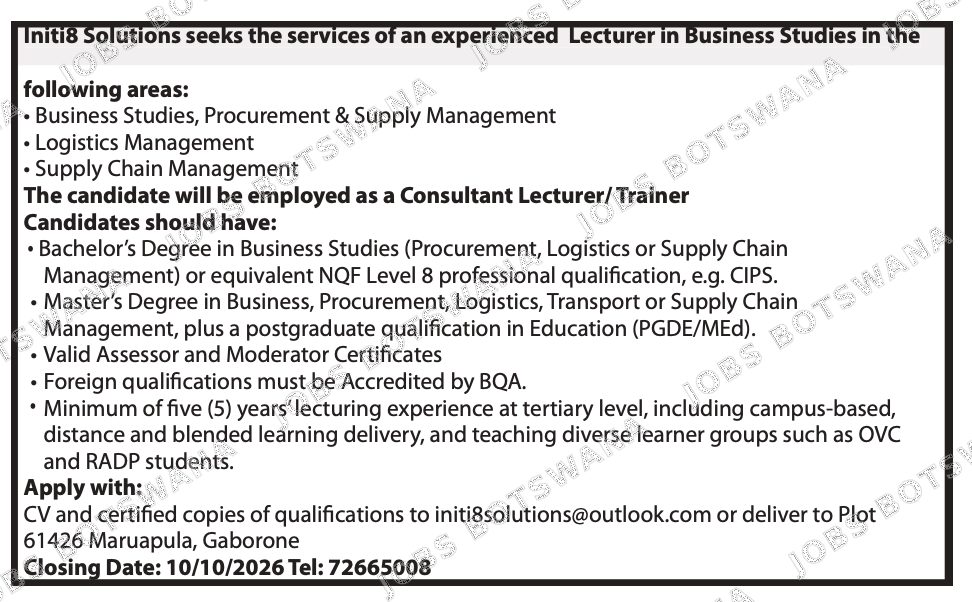
- Teach in the areas of Business Studies, Procurement & Supply Management, Logistics Management, and Supply Chain Management.
- Deliver instruction as a Consultant Lecturer/Trainer.
Requirements
- Bachelor’s Degree in Business Studies (Procurement, Logistics or Supply Chain Management) or equivalent NQF Level 8 professional qualification, e.g. CIPS.
- Master’s Degree in Business, Procurement, Logistics, Transport or Supply Chain Management, plus a postgraduate qualification in Education (PGDE/MEd).
- Valid Assessor and Moderator Certificates
- Foreign qualifications must be Accredited by BQA.
- Minimum of five (5) years’ lecturing experience at tertiary level, including campus-based, distance and blended learning delivery, and teaching diverse learner groups such as OVC and RADP students.
How to Apply
Original Advert
Source document for this listing, published by Jobs Botswana.
Frequently Asked Questions
What qualifications do I need to become a Lecturer in Business Studies in Botswana?
You typically need a Master's degree in Business, Management, or a related field as a minimum, though a PhD is increasingly preferred by institutions like the University of Botswana and BIUST. Professional certifications such as ACCA, CIMA, or CIM can strengthen your application. Prior teaching experience or industry experience in business is highly valued by employers.
What are the typical day-to-day responsibilities of a Business Studies lecturer?
Your duties include preparing and delivering lectures, developing course materials and assessments, supervising student research projects, and participating in departmental meetings. You will also be expected to engage in research and publish academic papers, as well as provide academic advising to students. Administrative tasks such as curriculum review and accreditation processes are common in Botswana institutions.
How does the work culture differ between public and private institutions in Botswana?
Public institutions like the University of Botswana tend to have more structured hierarchies, stronger union representation, and greater job security, but slower promotion processes. Private colleges and universities often offer more flexibility and faster career advancement, though with less job security. Both environments emphasize respect for seniority and formal communication channels typical of Batswana workplace culture.
What career progression opportunities exist for Business Studies lecturers in Botswana?
You can advance from Lecturer to Senior Lecturer, Associate Professor, and eventually Professor based on research output, teaching excellence, and years of service. Many lecturers also move into administrative roles such as Head of Department, Dean, or Deputy Vice-Chancellor. Some transition into consultancy, corporate training, or policy advisory positions with government bodies like the Botswana Qualifications Authority.
What benefits should I expect as a lecturer in Botswana?
Public institutions typically offer pension schemes through the Botswana Public Officers Pension Fund or similar arrangements, medical aid contributions, and generous annual leave often exceeding 30 days. Private institutions vary more widely but may offer competitive packages including performance bonuses and professional development funding. Housing allowances and relocation support are sometimes available, particularly for positions in remote areas like Palapye or Kanye.
How do I apply for lecturer positions and what do employers prioritize?
Applications are usually submitted through institutional websites or the Public Service Portal for government positions, requiring a detailed CV, certified academic transcripts, and references. Employers prioritize candidates with peer-reviewed publications, relevant teaching experience, and alignment with national development priorities like entrepreneurship and economic diversification. Demonstrating community engagement and understanding of Botswana's socio-economic context strengthens your candidacy significantly.